

Your ecommerce website exists in an increasingly complex digital environment where technical precision determines success. Search algorithms constantly evolve, AI overviews capture more screen space, and mobile-first indexing shapes every ranking decision. Without proper technical implementation, even the most beautiful product pages remain invisible to potential customers.
We work with ecommerce businesses daily, implementing strategies that turn organic search into predictable revenue streams. Whether you need an Ecommerce SEO Consultant to audit your current setup or comprehensive Ecommerce SEO Services to rebuild from the ground up, understanding technical ecommerce optimisation is crucial for sustainable growth. Our Ecommerce Agency has witnessed too many businesses struggle with poor site architecture, inadequate product page optimisation, and crawl budget waste that destroys organic visibility.
Technical ecommerce SEO requires more than keyword research and content creation. Search engines evaluate your site architecture, product page structure, internal linking patterns, and technical implementation before determining whether your products deserve visibility for high-intent commercial queries.
Understanding Modern Ecommerce SEO Challenges
Ecommerce SEO operates within unique constraints that don’t affect other website types. Your site must handle thousands of product variations, seasonal inventory changes, and complex filtering systems while maintaining search engine crawlability and user experience quality.
- Algorithmic complexity continues increasing as search engines implement AI-powered ranking systems. Google’s Product Review Algorithm specifically targets ecommerce content quality, while Core Web Vitals directly impact mobile commerce conversion rates.
- Search result evolution presents new challenges. AI overviews now appear for 15% of queries, reducing organic click-through rates by up to 64% when present. Featured snippets, shopping carousels, and visual search results compete for attention above traditional organic listings.
- Technical debt accumulation affects most ecommerce platforms. As product catalogues grow, sites develop crawl inefficiencies, duplicate content issues, and structural problems that compound over time without systematic maintenance.
Product Page Optimisation: Technical Implementation
Product pages represent the final conversion point in your ecommerce funnel. Technical optimisation must balance search engine requirements with user experience expectations while supporting various product types and configurations.
Schema Markup Implementation
Structured data provides search engines with explicit product information that enables rich results display. Proper schema implementation significantly increases click-through rates and improves organic visibility.
- Essential product schema elements include name, description, price, availability, review ratings, brand information, and SKU identification. Each element must reflect current product data and update automatically when inventory or pricing changes.
- Review schema integration displays star ratings directly in search results, dramatically improving click-through rates. Implement review markup at both product and aggregate levels to maximise visibility opportunities.
- Offer schema configuration handles complex pricing scenarios including sale prices, bulk discounts, and geographic pricing variations. This becomes critical for international ecommerce operations targeting multiple markets.
Technical Page Structure
Product page architecture must support both user navigation and search engine crawling while maintaining fast loading speeds across all device types.
URL structure standardisation ensures consistent product page addressing throughout your catalogue. Use descriptive URLs that include product names and relevant category information without creating excessive depth or parameter strings.
Internal linking optimisation connects related products, categories, and content pages through strategic link placement. Implement breadcrumb navigation, related product recommendations, and contextual category links that guide both users and crawlers through your site architecture.
Image optimisation protocols balance visual quality with loading performance. Implement responsive images, appropriate compression levels, and descriptive alt text that supports both accessibility and search engine understanding.
Category Page Architecture for Scale
Category pages serve as the organisational backbone of ecommerce sites, connecting broad search intent with specific product selections. Technical category optimisation enables scalable organic traffic growth across thousands of product groupings.
Faceted Navigation Management
Faceted navigation improves user experience but creates significant technical challenges for search engine crawling and indexing. Without proper management, filter combinations can generate millions of low-value URLs that waste crawl budget and dilute ranking signals.
Canonicalisation strategies consolidate similar filtered views to primary category URLs while preserving valuable filter combinations that target specific search queries. Use canonical tags to direct ranking signals toward your most important pages.
Parameter handling configuration prevents search engines from crawling irrelevant filter combinations while allowing access to commercially valuable filtered views. Configure URL parameters in Google Search Console to provide explicit crawling guidance.
Crawl budget optimisation ensures search engines focus on your highest-value pages rather than getting lost in infinite filter combinations. Monitor crawl stats regularly and adjust technical implementations based on actual crawler behaviour.
Content Strategy Integration
Category pages require substantial unique content to compete for competitive commercial keywords while maintaining user-focused design and functionality.
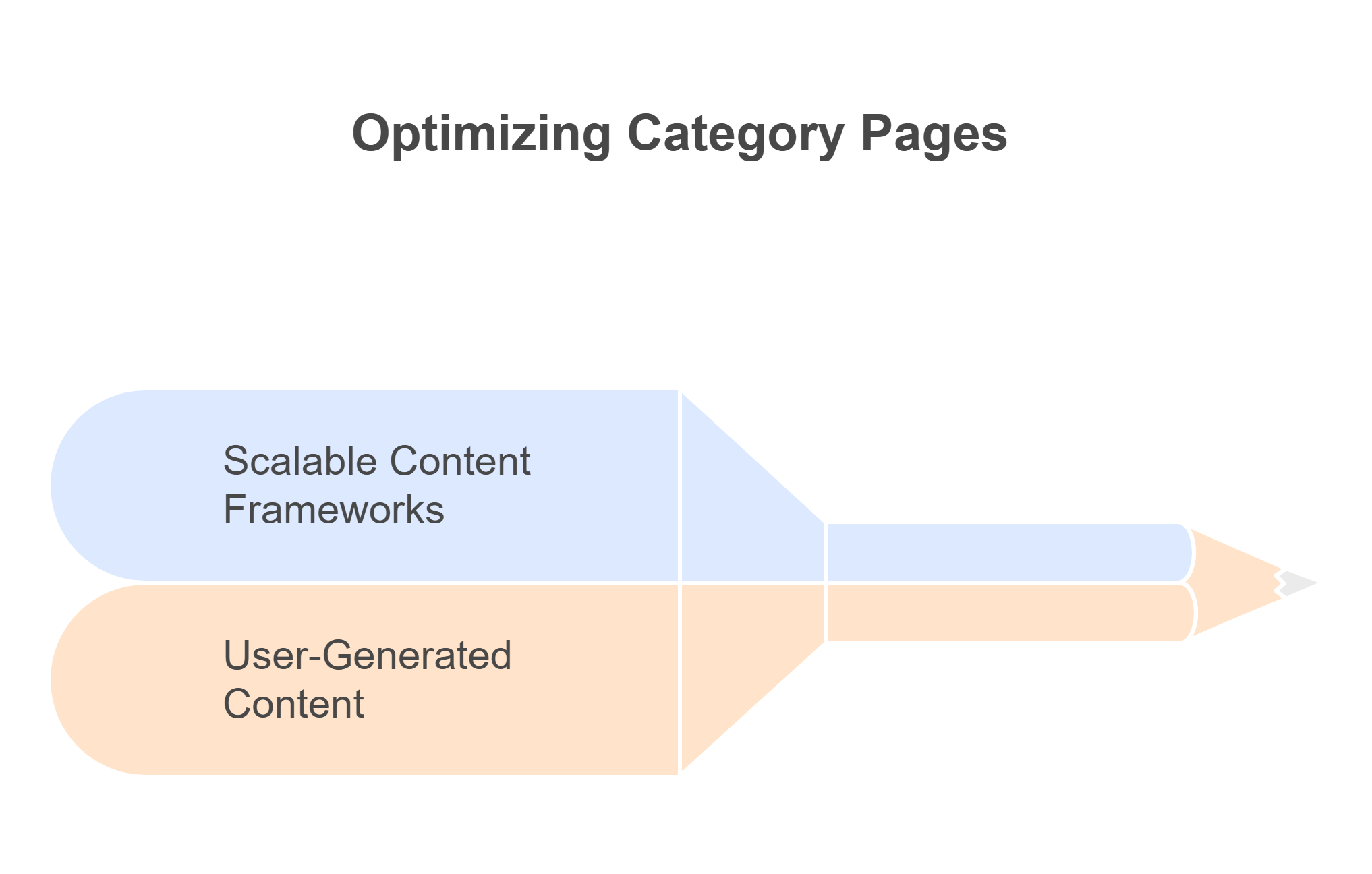
- Scalable content frameworks enable consistent category page optimisation across hundreds or thousands of product groupings. Develop templates that incorporate relevant search terms, product benefits, and buying guidance without appearing formulaic.
- User-generated content integration leverages customer reviews, questions, and product discussions to create fresh, relevant content that supports both SEO and conversion optimisation goals.
Australian Ecommerce Market Data 2025
Understanding the Australian ecommerce scenario provides crucial context for technical SEO decision-making and strategic planning.
Current Market Performance
According to the Australian Bureau of Statistics, online retail sales reached $4.7 billion in June 2025, representing a 3.9% monthly increase and 13.0% year-over-year growth. This demonstrates the continued expansion of Australian ecommerce markets despite economic uncertainties.
Sector-specific performance shows:
- Online food sales totalled $1.45 billion, growing 2.5% monthly
- Online non-food sales reached $3.25 billion, increasing 4.5% monthly
- Online sales now represent 12.7% of total retail trade, up from 11.9% in the previous period
Category distribution reveals:
- Food retailing online proportion increased to 7.2% of total food retail sales
- Non-food online sales captured 19.0% of total non-food retail activity
Source: Australian Bureau of Statistics – Retail Trade Australia, June 2025
This official government data indicates robust ecommerce growth across all major categories, with non-food categories showing particularly strong online adoption rates. The consistent monthly growth suggests sustainable market expansion rather than temporary fluctuations, making technical SEO investments increasingly valuable for Australian ecommerce businesses.
The higher growth rates in non-food categories reflect changing consumer behaviour and increased comfort with online purchasing for traditionally in-store products, creating opportunities for businesses with proper technical SEO implementation.
Site Architecture and Technical Infrastructure
Ecommerce sites require sophisticated technical architectures that support large product catalogues while maintaining search engine crawlability and user experience quality. Poor architectural decisions compound over time, creating technical debt that becomes increasingly expensive to resolve.
Scalable URL Structures
URL architecture decisions affect everything from internal linking efficiency to international expansion capabilities. Establish consistent patterns early to avoid costly restructuring as your catalogue grows.
- Category hierarchy implementation should reflect both user navigation patterns and business priority structures. Avoid excessive URL depth that creates crawling inefficiencies while maintaining logical product organisation.
- Product URL optimisation balances keyword inclusion with maintainability requirements. Include relevant descriptive terms without creating excessively long URLs that become difficult to manage at scale.
- Parameter management strategies handle complex ecommerce requirements like product variations, geographic targeting, and personalisation features without creating crawl chaos or duplicate content issues.
Technical Performance Optimisation
Site speed directly impacts both search rankings and conversion rates, making performance optimisation critical for ecommerce success. Slow-loading pages lose customers before they can evaluate product offerings.
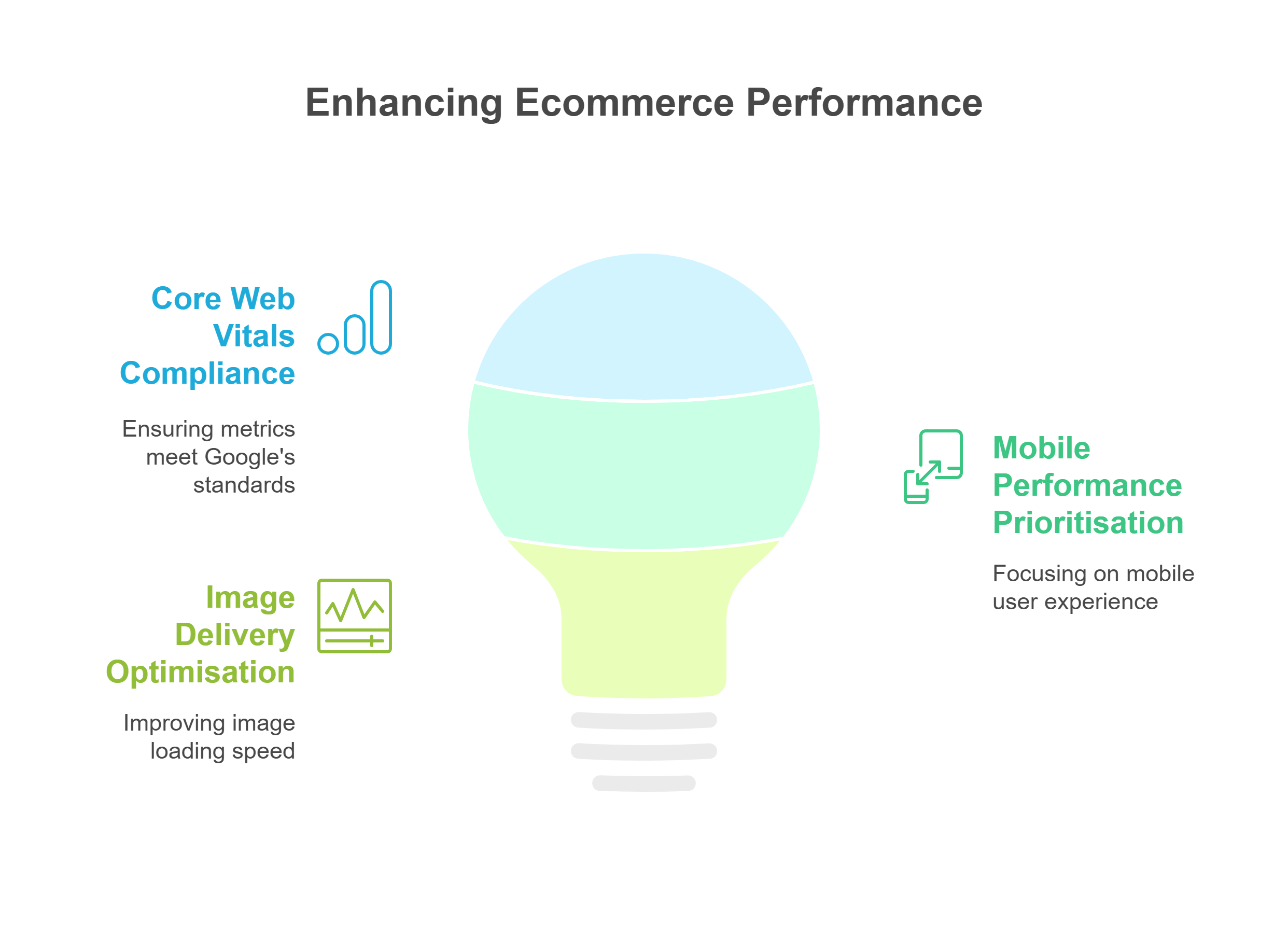
- Core Web Vitals compliance requires systematic optimisation across all page types. Largest Contentful Paint, First Input Delay, and Cumulative Layout Shift metrics must meet Google’s thresholds consistently.
- Mobile performance prioritisation becomes increasingly important as mobile commerce continues growing. Implement accelerated mobile pages or progressive web app technologies where appropriate for your target audience and technical resources.
- Image delivery optimisation represents the largest performance opportunity for most ecommerce sites. Implement modern image formats, responsive loading, and content delivery network distribution to minimise loading delays.
Advanced Technical Implementation
Modern ecommerce SEO requires sophisticated technical approaches that go beyond basic optimisation tactics. These advanced implementations often determine the difference between sites that scale successfully and those that stagnate.
Programmatic SEO Applications
Large product catalogues benefit from systematic, programmatic approaches to content creation and optimisation. Rather than manually optimising individual pages, develop systems that apply best practices automatically across thousands of products.
Template-based optimisation ensures consistent implementation of technical requirements across all product and category pages. Build flexibility into templates to handle product variations without sacrificing optimisation quality.
Dynamic content generation creates unique, relevant content for product combinations and filtered views that target specific search queries. Use product data, customer reviews, and market research to generate authentic content at scale.
Automated testing frameworks monitor technical implementation quality across large catalogues. Identify and resolve issues before they impact search visibility or user experience.
“Technical precision in ecommerce SEO isn’t just about following best practices—it’s about building systems that maintain optimisation quality while scaling across thousands of products and category combinations.”
International Expansion Considerations
Growing ecommerce businesses often expand into multiple geographic markets, requiring technical implementations that support international SEO without creating maintenance burdens.
Hreflang implementation for ecommerce sites involves complex product availability, pricing, and currency considerations across different markets. Ensure proper signal implementation while maintaining accurate product information for each target market.
Multi-currency technical handling affects everything from structured data markup to internal linking strategies. Implement systems that maintain SEO best practices while supporting complex international commerce requirements.
Regional content management scales international operations through systematic approaches to product descriptions, category content, and localised search optimisation.
Monitoring and Measurement Systems
Ecommerce SEO success requires sophisticated measurement approaches that connect technical optimisation efforts with business outcomes. Revenue attribution, conversion tracking, and performance monitoring must work together to guide strategic decisions.
Revenue-Focused Analytics
Track metrics that directly correlate with business growth rather than vanity metrics that don’t influence revenue outcomes. Focus on organic traffic that converts and technical improvements that enhance user experience.
- Conversion path analysis reveals how organic search traffic moves through your site architecture and identifies technical barriers that prevent successful transactions.
- Product-level performance tracking identifies which optimisation efforts drive the highest return on investment and guides resource allocation across large product catalogues.
- Technical health monitoring provides early warning of crawl issues, performance degradation, or structural problems that could affect organic visibility.
FAQs
Q: How long before technical ecommerce SEO improvements show results?
A: Technical improvements typically show initial impact within 4-8 weeks, with full results visible after 3-6 months. Page speed optimisations and structured data implementation often show faster results than architectural changes.
Q: Should I focus on technical SEO or content creation first?
A: Technical foundation must come first. Poor site architecture, slow loading speeds, or crawl issues will limit content effectiveness regardless of quality.
Q: How do I handle SEO for products with multiple variations?
A: Use canonical tags to consolidate ranking signals, implement proper structured data for each variation, and create clear internal linking between related products.
Q: What’s the biggest technical SEO mistake ecommerce sites make?
A: Ignoring crawl budget management. Large catalogues often waste crawler resources on low-value pages while important product pages remain undercrawled.
Q: When should I hire an ecommerce SEO consultant?
A: Consider professional help if you’re managing 1,000+ products, expanding internationally, experiencing declining organic traffic, or lack internal technical SEO expertise.
Building Future-Proof Ecommerce SEO Systems
Ecommerce SEO continues evolving as search engines implement more sophisticated algorithms and user behaviour shifts toward mobile and voice-driven interactions. The businesses that succeed build technical foundations capable of adapting to these changes without requiring complete rebuilds.
- AI integration opportunities emerge as search engines incorporate machine learning more deeply into ranking algorithms. Sites with clean technical implementations and high-quality user experience signals will benefit most from these algorithmic improvements.
- Voice commerce optimisation requires technical implementations that support conversational queries and natural language product discovery. Structured data becomes even more critical as voice assistants rely on explicit product information.
- Visual search preparation involves technical optimisations for image-based product discovery. High-quality product images, descriptive alt text, and proper schema markup support emerging visual search technologies.
Technical ecommerce SEO isn’t just about following current best practices, it’s about building systems that maintain competitive advantages as the digital commerce scenario continues evolving. The Ecommerce Marketing Agency partnerships that succeed focus on sustainable technical implementations rather than quick fixes that create long-term problems.
Whether you’re launching a new ecommerce site or optimising an existing catalogue, technical precision in SEO implementation often determines the difference between businesses that grow sustainably through organic search and those that remain dependent on paid advertising for customer acquisition.
The Australian ecommerce market’s continued growth demonstrates the opportunity available for businesses that invest in proper technical SEO foundations. As online retail captures an increasingly large share of total commerce, the companies with superior technical implementations will capture disproportionate market share through organic search visibility.
Author

Table of Content
5 Min Read
Get more expert digital marketing insights from us in your Google Search results.

